Watching your baby pull themselves up for the first time is exciting, and it's natural to want to help them take the next step. A lot of parents ask the same two questions right around this stage: are baby walkers actually safe, and when is my baby ready for one? Here's the honest answer to both.
Are baby walkers safe?
It depends which kind you mean, and this is the part most parents don't realise until they're standing in the aisle trying to choose one.
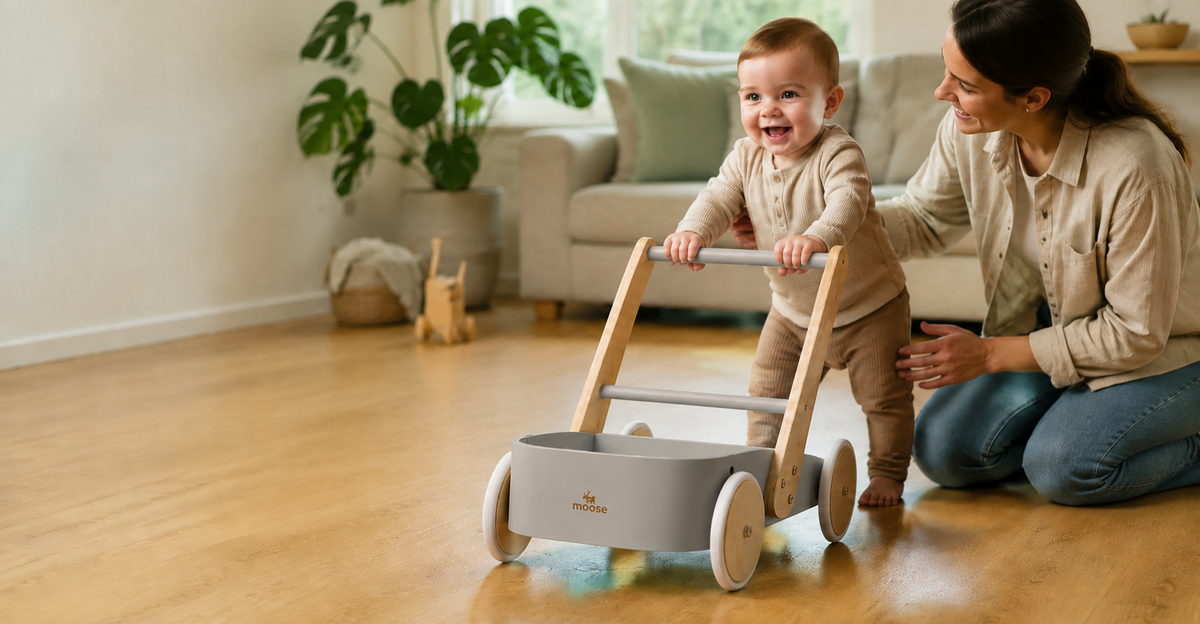
There are two very different products both called "baby walkers." The first is a seated walker, the kind with wheels that a baby sits inside and scoots around in with their feet on the floor. In fact, that's the exact legal definition under New Zealand's own safety regulations: a frame on wheels that supports a child inside it, feet touching the ground. The second is a push walker, a frame or cart your baby stands behind, holds onto, and pushes forward on their own two feet.
Seated walkers are the ones parents are warned against. Whānau Āwhina Plunket has campaigned against them for years, calling them "accidents on wheels," and Auckland's Starship Children's Hospital admits around one child a month for injuries related to them. Because of the risk, New Zealand has mandatory safety regulations specifically for seated walkers, enforced by the Commerce Commission, and Plunket's own advice is direct: they don't recommend them, because they don't help babies learn to walk and can cause serious injuries.
Push walkers are a different story. Your baby stays upright, in control, and moving at their own pace the whole time. That's not a technicality, it's the actual thing that makes one safe and the other not.
So if you're asking "are baby walkers safe," the real question is "which kind." A seated one, no. A push walker, yes, when your baby is ready and you're nearby.
When can baby use a walker?
Most babies are ready for a push walker once they're pulling themselves up to stand and cruising along furniture, usually somewhere between 9 and 12 months. There's no exact date. Some babies get there a little earlier, some a little later, and that's completely normal.
The walker isn't there to rush your baby into walking. It's there to give them something steady to hold onto while they build the strength and balance to do it themselves. If your baby isn't pulling up to stand yet, they're not ready, and that's fine. Wait until they show you.
Do baby walkers help or hurt development?
This is where the seated-vs-push distinction matters again. Plunket's guidance is blunt: seated walkers don't help babies learn to walk. Sitting and scooting is a completely different movement pattern from standing and stepping, so time spent in one doesn't build the muscles or coordination your baby actually needs.
A push walker does the opposite. Your baby is standing, bearing their own weight, and practising the exact motion of walking every time they use it. That's the difference between a toy that looks like it helps and one that actually does.
Baby walker pros and cons
The upside of a push walker:
- Builds real leg strength and balance
- Gives a nervous new walker something to hold onto
- Keeps your baby upright and in view the whole time
- Often doubles as a toy cart long after those first steps
The downside:
- Your baby still needs supervision, it's a support tool, not a babysitter
- It won't make walking happen faster than your baby is ready for, and that's a good thing
If you're considering a seated walker instead, Plunket's advice is clear: skip it. The injury risk and the lack of any real developmental benefit outweigh the convenience.
Want to see how it holds up in real life? Read what twins Reuben and Oliver's mum thought after putting the Moose Baby Walker to the test.